Agricultural Rosie: Hazel Frye
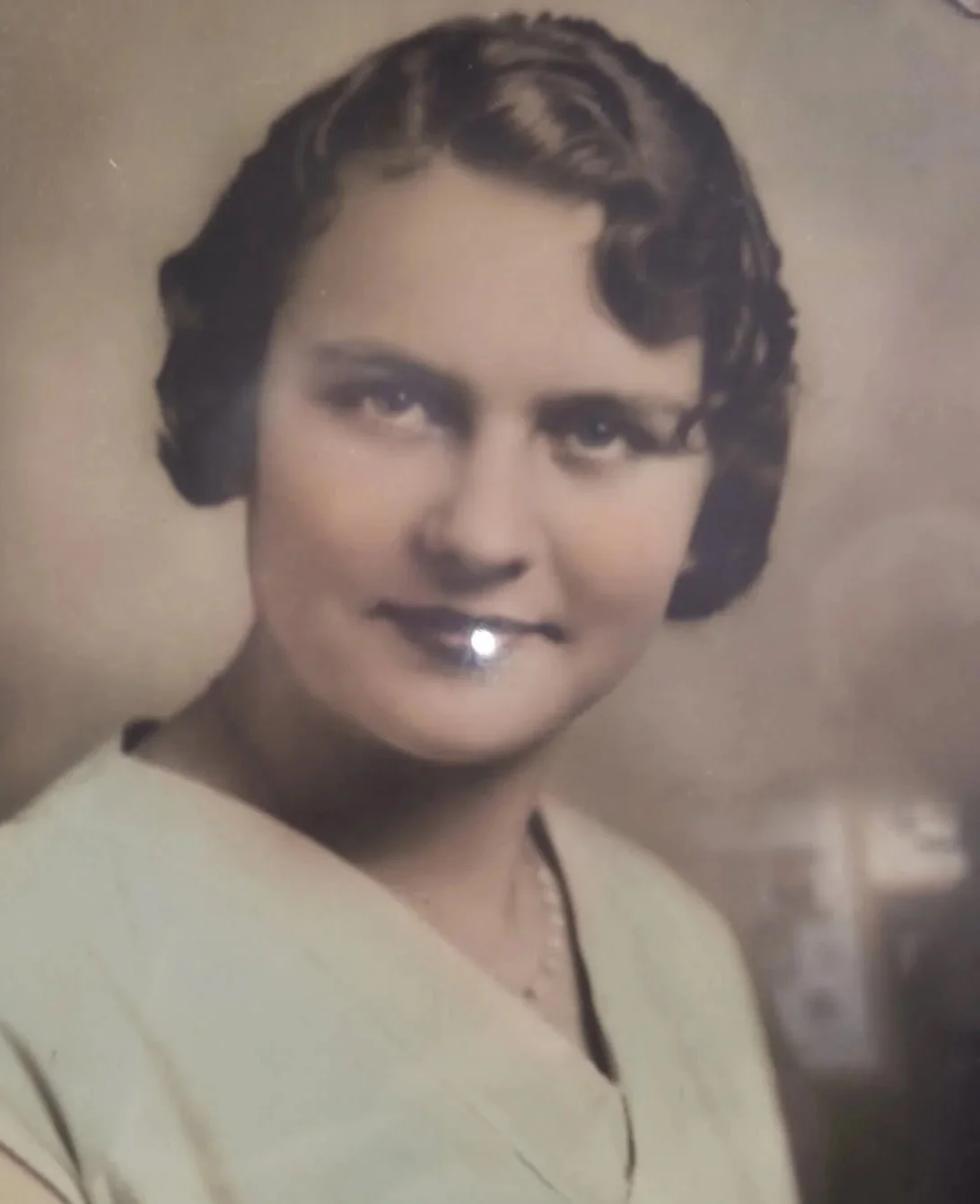
The Story of Hazel Frye, as told by daughter VaLois Frye Burns
Hazel graduated from high school in Gladwin County and then attended County Normal School. Because of her age and the customs of the time, Hazel’s father had to sign her teaching contract with Gladwin County Schools. She was considered capable of molding young minds, but not trusted to sign her own contract. After teaching for a few years, Hazel married and settled into life as a farmer’s wife.
Around the beginning of World War II, the family moved to Plymouth and bought a farm on Beck Road. At that time, Plymouth was almost entirely farmland. Hazel’s daughter, VaLois, was in grade school and remembers the wartime blackouts. She recalls milking cows at night with no lights in the barn. Her father worked at Kelsey-Hayes in Plymouth, where machine guns were being manufactured for the war effort.
At dinnertime, the family listened to the radio for war news instead of chatting. VaLois and her brother were frightened by the war and lived with the constant fear that the Japanese might be “right down the road.” VaLois was even afraid to go to the outhouse at night. The family churned their own butter and sold some of it on the wartime black market.
Hazel used an old hand-crank butter churn and one day, she had been reminding VaLois all morning to help churn the butter. VaLois dawdled, and not realizing her mother had already finished churning it, when she finally got to the churning, butter flew everywhere because it was already done and the spigot was open!.
They allowed a married couple who worked at the Willow Run bomber plant to set up a trailer in their backyard. During blackout emergencies, the couple would come into the house. While living on the Plymouth farm, VaLois’s father was hospitalized with tuberculosis. During that time, her mother took on even more responsibility running the farm. She would put the baby in a bassinet attached to the utility vehicle and go out to the fields to finish the plowing activities needed for planting.
Plowing was a multi-step process. First, the field was plowed to turn over the sod, which left roots sticking up and the ground rough. The next step was disking, using a machine with two rows of discs—sixteen discs per row—to cut up the roots. That was the part VaLois’s mother handled. Depending on how the field looked after the first disking, a second pass might be needed. The final step was running a cultipacker over the field to smooth the soil and prepare it for planting. Much of this work depended on the weather and the type of soil, whether sandy, clay, or a mixture of both. It takes knowledge and experience to be a farmer.
For entertainment, if they had enough gas, the family would drive around and look at other farms. They especially admired straight cornrows, which were a sign of a highly skilled farmer. Today, GPS technology makes straight rows common, but back then, it reflected the farmer’s true skill. One special wartime treat was when the family saved and scraped together enough money to buy a player piano. From then on, there was always music in the house.
A favorite family saying was, “If foresight were hindsight, we’d be better by a darn sight.” With Hazel’s husband still sick with TB, the family had to abandon the Plymouth farm and moved back to Gladwin, where Hazel began teaching again. VaLois’s father remained ill.
As a country kid during the war, VaLois waited for the school bus each day, which left a little time after school. She was assigned to help in the library, where the librarian asked her to evaluate books—an experience that quietly shaped her love of reading and learning.
VaLois often shares advice she believes children can learn from the “Rosies.” “Children learn by imitation and are naturally open to experience,” she says. “ Women have evolved, and Rosie’s daughters and granddaughters are far more valued as women workers today.” VaLois believes kids can learn from the Rosies not only through their strong character, but also through their ability to be silly and enjoy life. There were many silly dances and songs in the 1940s—like “Mairzy Doats”—and a lot of joy, especially after the war ended. Children can relate to that fun while also learning resilience and character.
When push comes to shove and pressure is on, VaLois believes we must find solutions within ourselves and do what we can. We should remember that we’re entitled to make mistakes. And, VaLois says, “If your dreams don’t scare you, you need to dream bigger!” The lesson to learn from the Rosies is that you can do it!